Wednesday, October 24, 2018

Book Review: LikeWar (Peter W. Singer, Emerson T. Brooking)

TL;DR


Buy it here!

Summary


There are some great stories in this book. From Mike Flynn's real role pre-Trump Admin, to a hundred other people's stories as they manipulated social media or tried to prevent it in order to have real world effects. This book draws a compelling narrative. It's well written and it holds your interest.

That said, it feels whitewashed throughout. There's something almost ROMANTIC about the people interviewed through much of it. But the particular take the authors have on the problem illustrates an interesting schism between the technical community and the academic community. For example, in the technical community, the minute you say something like this, people give you horrible looks like you were doing a Physics lecture and somehow wanted to tie your science to a famous medieval  Alchemist :

Highlight (yellow) - Location 307

Carl von Clausewitz was born a couple of centuries before the internet,
but he would have implicitly understood almost everything it is doing to
conflict today.
What's next? OODA Loops?!? Sheesh.

In a way though, it's good that the book started this way, as it's almost a flare to say exactly what perspective the book is coming from.

Two other early pieces of the book also stuck out:
Highlight (yellow) - Location 918

For it has also become a colossal information battlefield, one
that has obliterated centuries’ worth of conventional wisdom
about what is secret and what is known.
And:
Highlight (yellow) - Location 3627

And in this sort of war, Western democracies find themselves
at a distinct disadvantage. Shaped by the Enlightenment,
they seek to be logical and consistent. Built upon notions of transparency,
In other words: This book has a extreme and subjective view of government and industry and an American perspective. Its goal is often less to explain LikeWar than to decry its effects on US geopolitical dominance. We have a million Cleared individuals in the US. Are we really built on notions of transparency? This would have been worth examining, but does not fit with the tenor of the author's work here.

The book does bring humor to its subject though and many of the stories within are fleshed out beyond what even someone who lived through them would remember, such as a detailed view on AOLs early attempts to censor the Internet:

Highlight (yellow) - Location 4203

AOL recognized two truths that every web company would
eventually confront. The first was that the internet was a teeming
hive of scum and villainy.

Missing in Action

That said, anyone who lived through any of the pieces of this book will find lots missing. Unnoticed is the outsided role of actual hackers in the stories that fill this book. It's not a coincidence where w00w00 or Mendax ended up, although it goes unmentioned. And the role of porn and alternative websites is barely touched upon. How the credit card companies have controlled Fetlife would be right in line with what this book should cover, yet I doubt the authors have heard of FL (or for that matter could name the members of w00w00). Nor is Imgur mentioned. It's also not recognized that the same social network the intelligence community uses to publish their policies (Tumblr) is 90% used for browsing pornography.

Clay Shirky, the first real researcher into this topic, who gets one mention in the book (iirc), pointed out that whenever you create a social network of any kind, it becomes a dating site. This is one of those axioms that can produce predictive effects on the subject matter at hand. Sociology itself has been revolutionized by the advent of big data from Big Dating. The very shape of human society has changed, as the spread of STDs has pointed out. And the shape of society changes War, so this book could be illustrating it.

At its most basic example, examining social networks involves looking for network effect - the same thing that drives most dating sites to create fake profiles and bots so they can convince people to pay for their service. These are primal features of the big networks - how to get big and stay big. As Facebook loses relevance, Instagram gains it, and as Instagram loses it....we didn't see any of this sweep in the book. Some topics were too dirty, perhaps?

Conclusion


Like many books coming out, this book is a reflexive reaction to the 2016 election and nowhere is that more evident than in the conclusion.

Some statements are impossible to justify:
Highlight (yellow) - Location 4488

Like them or hate them, the majority of today’s most
prominent social media companies and voices will
continue to play a crucial role in public life for years to come.
Other statements are bizarre calls for a global or at least American censorship regime:

Highlight (yellow) - Location 4577

In a democracy, you have a right to your opinion, but no
right to be celebrated for an ugly, hateful opinion, especially
if you’ve spread lie after lie.
The following paragraph is not really true, but also telling:
Highlight (yellow) - Location 4621

Of the major social media companies, Reddit is the only one that preserved the known fake Russian accounts for public examination. By wiping clean this crucial evidence, the firms are doing the digital equivalent of bringing a vacuum cleaner to the scene of a crime. They are not just preventing

The authors, like many people, see the big social networks as criminal conspirators, responsible for a host of social ills. But for the past generations we have "Taught the Controversy" when it comes to evolution in our schools and it's hard to be confused as to why the population finds it hard to verify facts.

Instead of trying to adjust our government and society to technological change, we've tried to stymie it. Why romanticize the past, which was governed by Network News, the least trustworthy arbiters of Truth possible? We've moved beyond the TV age into the Internet age, and this book is a mournful paean to the old gods, rightfully toppled by disintermediation.

Still worth a read though.

Tuesday, October 2, 2018

"Own your data"

In today's edition of "trying to figure out what things in the cyber policy world really mean" I want to highlight this extremely insightful thread on "Owning your data".


Obviously you're never going to get AccessNow and FS-ISAC or any other group to agree on what that means. But sometimes it's worth noting that a particular terms one of the policy groups is pushing doesn't really mean anything at all or (as in the case of "Surveillance software") encompasses a lot more than they want you to think it does.

Friday, September 28, 2018

Forecasting vs Policy Work

No castle in Games of Thrones is complete without an extremely accurate map room! Apparently satellite imagery was available to all at a good price point.


Like many people in the business I'm a fan of the work of "StratFor", which is an ex-spook shop that does what they call "Strategic Forecasting" of geopolitical change. If you read their work carefully, a large amount of their methodology is an attempt to avoid a bias towards assuming that national or political leaders matter. 

If you just assume that every country has a set of resources and goals, and that it will act in its best interests, regardless as to who gets voted President, then over a long enough term you have a much better chance of making accurate predictions, is their play. 

It's an attempt to discover and analyze the emergent behavior inherent in the system, as opposed to getting caught up doing game theory and monte carlo simulations until the end of time. Using this mindset produces vastly different results from most predictive methods, and the cyber tilt on the playing field is notable. Early StratFor predictions used fundamentals such as the aging population or shrinking workforces in various countries, and indicated they would need to vastly increase unskilled labor pools by importing workers, but of course, modern predictions look at this as a gap automation will fill. 

But you can still look at the fundamentals - what resources do countries have, what are their geopolitical strengths and weaknesses and how will they be able to maintain their position using their resources. Geopolitical positioning has been altered by the Internet, of course, as everything has. And a large internet company is its own kind of resource. 

This is why when a paper comes out saying that Germany will have a strong VEP leaning towards disclosure any decent forecaster is going to look at that as an oddity. We are now, and have been for a long time, in a great-powers competition meta. Germany needs to ramp up as soon as possible on both its defensive and offensive capabilities. The real question is how close it gets to the 5EYES in order to do so. You can make these predictions without looking at all at who's in charge, or what the politics are.

The one hole, of course, that seems obvious in retrospect, is that non-state actors are vastly more important than any Westeros map can capture. Everyone asks about the Cyber-9/11 and then goes on to talk about Russia and China as if it was a Taliban plot to hit the WTC. In other words, we may be looking in the wrong direction entirely.


Tuesday, September 18, 2018

Equities issues are collectives

One of the great differences between people who've dealt with exploits their whole lives and people who are in the national security policy space just starting with exploits is the concept of an exploit being a singular thing. If you've tried to hack into a lot of networks, you generally view your capabilities as a probabilistic function. The concept of making a one-by-one decision on how releasing any particular vulnerability to the vendor would affect your future SIGINT is an insane one since the equities issues are a "collective" noun.

LINK (This equities issue argument made here about the Trump admin declassifying FBI texts is  familiar to those of us to follow the VEP)

As you can see above the "presumption of public disclosure" line feels almost stolen directly out of one of Stanford or Belfer's VEP papers.

Monday, September 10, 2018

Why Overwatch?


So we've done a number of Overwatch-related posts on this blog. And I wanted to talk about the method behind the madness. First of all, I wanted to talk about what you see when you read cyber policy papers: simple game theory inspired by the arguments around nuclear deterrence.


The problem with this kind of work is that no matter how many variables people add to these models, they don't capture the nature of either cyber offense or cyber defense in a way that can start to predict real world behavior.

Practitioners have other frameworks and models (c.f. Matt Monte's book), and the one I've chosen is Overwatch for the following reasons:


  • Overwatch is extremely popular in the hacking community and almost universally well understood, even at the highest levels (more so than other sports, such as Football or Basketball). It's possible this is because Overwatch's themes and story resonate strongly in this day and age, for reasons beyond this blog.
  • As an E-sport, tactical development in Overwatch is directly measured and both teams are on identical ground (no amount of steroids can overcome a bad strategy)
  • The diverse character set and abilities explore nicely the entire space of possibilities and translates well to the cyber war domain
  • Overwatch analysis has a rich, coherent and well understood terminology set (Shotcallers, "Sustain", win-condition, Deathballs, meta changes, team-comp, wombo-combos, etc.). 


This keynote explains our model for adversarial action in the cyber domain using Overwatch analogies.

Immunity is not the only team to use this kind of language to develop an analysis framework for extremely complex systems. An extremely popular series of biology videos on YouTube right now is the Tier Zoo videos, where he discusses various animals as if they were playable Overwatch character classes. The key thing here being: This is a much more illuminating way to classify survival strategies than you might have imagined. And of course, it demonstrates this model works at the most complex levels available (aka, the real world).

Treating cyber security offense and defense as discrete automata may still provide some value for policy decision making, but it is more likely that an Overwatch-based model will be able to provide predictive value - much as simple expert systems have now been replaced for complex decision making by deep learning algorithms.


Friday, September 7, 2018

Paper Review: The Security Risks of Government Hacking by Riana Pfefferkorn

https://twitter.com/StanfordCIS/status/1037401854324264961

Ok, so after I did a review of the German VEP paper, Riana pointed me at her paper. Academics have thick skins as a rule, so I went through and live tweeted a response, but she is owed a deeper review, on reflection.

First of all, I am often chided for lumping all policy people together, or being overly derogatory towards the efforts of policy people in this area who are not also subject matter experts. But it has not gone unnoticed that there are fundamental problems with study in the area, most recently this article on CFR and this Twitter thread.

When you talk to major funders in this area they complain that "Every paper I read is both the same, and entirely irrelevant". And the reasons why get dissected pretty well by that CFR post as quoted below:
There are three categories of factors that make scholarly cyber conflict research a significantly more challenging task than its nuclear era counterparts: (1) the characteristics of the threat space, (2) data availability constraints, and (3) the state of political science as a discipline.
Historically, and luckily, when non-subject matter experts attempt to draw conclusions in this field they make glaring and weird mistakes about the history of the subject. This is most often to attempt to back up the trope that cyber tools are extremely likely to get caught, and then when caught are used against everyone else.  (You can see another example of someone without any technical experience doing the same kind of thing here.)

Below (from page 9 of the paper) Riana makes some very odd claims:
In another example, after nation-state actors widely believed to be the United States and Israel unleashed the so-called Stuxnet malware to undermine Iran’s nuclear program, new malware which was in part identical to the Stuxnet code appeared on the internet.25 Researchers also discovered additional types of malware that used Stuxnet’s USB port infection technique to spread to computers.26
The reality is of course more complex, but it worries me that when reading the released reports on Stuxnet, Duqu, and Gauss, she did not appear to understand the sweep of how things fit together. The technical concepts of how code works cannot be avoided when making policy claims of this nature, and it has the problem of invalidating other arguments in the paper when this sort of thing is broken from the very beginning.

Likewise, when talking about bug rediscovery, it's impossible to discuss these things by giving equal weight to two papers with completely different results. It's like CNN trying to give equal weight to a climate change denier and an atmospheric scientist.

But that's what we see in Riana's paper.
Trey Herr, found rediscovery rates of 14% to 17% for vulnerabilities in browser software and 22% for bugs in the Android mobile operating system.5 After their conclusions were criticized as inaccurate, Schneier and Herr updated their paper, revising their rediscovery rates slightly upward and concluding that “rediscovery takes place more often than previously thought.”6 On the other hand, the RAND Corporation issued a report analyzing a different set of data and put the rediscovery rate at only about 5% per year.7 
I'm fairly sure they revised their rates downwards, and not upwards? It doesn't matter though. It's impossible to draw the kinds of conclusions you would want from any of these numbers, as she goes on to state a few paragraphs later:
Ultimately, experts do not precisely know the rediscovery rate for any specific vulnerability or class of vulnerabilities, and aren’t going to know anytime soon. 
Then there are paragraphs which try to push a political agenda, but don't have a grasp on the history of how vulnerabilities have been handled. None of the claims here can be substantiated, and many of them are pure fantasy.
Today we have companies that are in the business of developing and selling 0-days, with no intention of revealing the flaw to the vendor so that it may be fixed. 0-days are generally used by state actors, may not be very common, and are not the biggest security problem out there. The existence of a market for 0-days may incentivize the discovery of more vulnerabilities. Some think that could lead to better security overall, so long as the government buying the 0-day ultimately discloses it to the vendor to be fixed. But that assumes 0-days are relatively rare; if they are plentiful, then an active 0-day market could be harmful.
The market for bugs has always been a smaller part of the larger community of people who find, use, and trade bugs, which existed long before there were governments in the game. The commercial consulting market dwarfs the government market, and is largely in the same exact business.

And governments are not a free bug-bounty program - they don't buy bugs to then disclose them to a vendor. That would be an exceedingly poor use of tax money.

Some parts of the paper, of course, highlight common-sense areas where there are wide policy gaps.
Judges issue hacking warrants ex parte based on the assurances of the government, but those representations may not capture the hacking campaign’s impact on people for whom there is no probable cause to believe they have committed any crime. As its use of hacking techniques continues and expands, it will be important for the government to narrowly tailor hacking campaigns to minimize impact on innocent users and to explain the expected impact accurately to the authorizing judge. 
Most substantially, I thought the paper represented a cautionary note against using Government Hacking as a policy bulwark against government mandated backdoors, which are on their face, a simpler, less chaotic, policy.

The problem however, is without deeply understanding the technical details this kind of paper can only misrepresent and over-abstract the risks on both sides. In that sense, it does more to muddy the issue than clarify it, even as it claims in the conclusion to want to further the discussion.


Wednesday, September 5, 2018

The German VEP

Most policy-work is still done in the reverse of logic, with gestaltian leaps of faith covered in heaping gobs of wishful thinking as to cause and effect. Vulnerability Equities Process papers are especially susceptible to this, because the Mozilla and Microsoft lobbyist team is punching well above their weight and has turned it into a "moral human rights" issue in the EU, to try to get codified in law what they could not do in the United States, because what's good for Mozilla is not necessarily good national policy.

This is especially true for Germany though! Germany is a huge industrial state at great risk for information operations and more direct cyber attack, that manufactures factories, but is notably behind on its own offensive capabilities. Sven Herpig's proposed VEP policy (for Germany, and the EU in general) would be like trying to catch up in the America's Cup Yacht race, but without pulling up your anchor.

However, that is gestaltian thinking at work! And I have been trying to propose a more rigorous process for looking at policy papers. And it is this:

  • Convert proposed language into flowchart
  • Use boolean alegebra to simplify flowchart (see below for the 4d4 Wassenaar flowchart, rearranged to demonstrate the real structure)
    • Look at whether any parts of the flowchart imply other parts (for example, all places that STORE data in a database also obviously INDEX it, etc.) Sometimes what looks like a large technical differentiation chart can be reduced by inference.
  • Make a spreadsheet of scenarios for regression testing all proposed changes to the text
  • Use GIT or other version tracking to attach rationals and other notes to proposed changes in language
  • Look at the total return on investment of the proposal, given the regression testing results
  • When people adjust the language, don't let them assume an effect, but go through the entire regression test again with the new language. THIS FINDS WEIRD THINGS.

This diagram is much more useful for running sample scenarios through than the language in WA itself, imho.

So when looking at VEP proposals in general, it's possible to say uncontroversially that this is a new area for governments, and that law in particular has been "not great" at dealing with rapidly changing environments in the cyber domain, and that therefor it is always fascinating when, without doing this kind of work or without testing their VEP for a decade or so, people want to en-scribe a particular VEP into their law (Sven's proposal sunsets the law after five years - but most laws in this space get automatically renewed, so that is of little comfort in terms of malleability). If your update process is crazy expensive and difficult, it makes more sense that you would test everything for many years, before shipping it, right?

Regardless, let's look at the details of Sven's proposal in detail, as promised.

The first thing is he pre-frames the argument with his title:
Weighing Temporary Retention versus Immediate Disclosure of 0-Day Vulnerabilities

But those are not the only options. Obviously indefinite retention is an option, as are many other things that happen in practice but make poor policy papers, for example, having the Government distribute patches themselves, or special purpose workarounds, or any number of other creative things which enable NOBUS, for example.

So one sample scenario spreadsheet to help make decisions about the proposed German VEP is here. It is not comprehensive, but it's similar to the ones I've made for export control language proposals.

There's a lot of negative results in the spreadsheet, but if someone who is pro-VEP wants to take a crack at it, I'm happy to send over the editing rights to the document, although obviously my opinion is that this is because on the whole, this policy proposal is a bad idea for Germany and the EU.

That said, I think "not addressing the negative repercussions" is the strategy of choice for the lobbyist teams who want to push this sort of thing forwards, but there's a reason particular gaps and flexibilities were built in the US VEP and it's not that they didn't think of all the various issues or just really like keeping 0day in a giant horde like a dragon sitting on a gold pile in a cave somewhere underneath Ft. Meade.

----
Additional CinemaSIN:
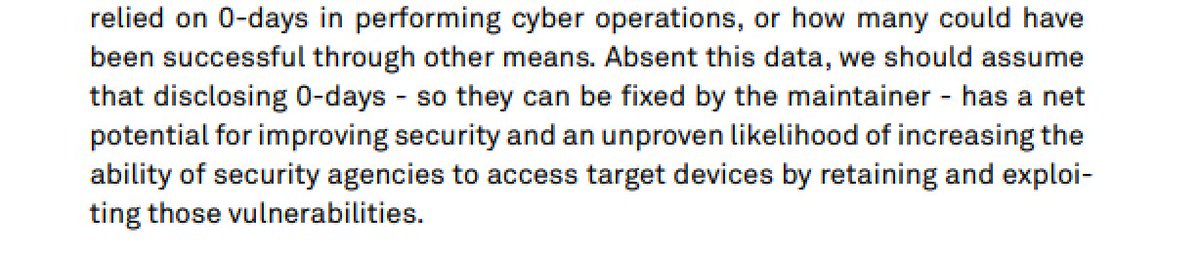
Why do policy people just do "Absent data, we can assume X" as a thing?

This is an especially terrible paragraph in the German VEP paper.


And for bonus negative points:

I think it's worth pointing out that making decisions on bad data is in no way better than than making decisions on no data. In fact, it's probably worse, since you have a higher confidence level in your decisions when you make them on data.

And, for the record, I engage in Cyber Policy work because we've been wandering in the desert for what seems like 40 years, and it's time to head in a direction of some sort.