Wednesday, September 5, 2018

The German VEP

Most policy-work is still done in the reverse of logic, with gestaltian leaps of faith covered in heaping gobs of wishful thinking as to cause and effect. Vulnerability Equities Process papers are especially susceptible to this, because the Mozilla and Microsoft lobbyist team is punching well above their weight and has turned it into a "moral human rights" issue in the EU, to try to get codified in law what they could not do in the United States, because what's good for Mozilla is not necessarily good national policy.

This is especially true for Germany though! Germany is a huge industrial state at great risk for information operations and more direct cyber attack, that manufactures factories, but is notably behind on its own offensive capabilities. Sven Herpig's proposed VEP policy (for Germany, and the EU in general) would be like trying to catch up in the America's Cup Yacht race, but without pulling up your anchor.

However, that is gestaltian thinking at work! And I have been trying to propose a more rigorous process for looking at policy papers. And it is this:

  • Convert proposed language into flowchart
  • Use boolean alegebra to simplify flowchart (see below for the 4d4 Wassenaar flowchart, rearranged to demonstrate the real structure)
    • Look at whether any parts of the flowchart imply other parts (for example, all places that STORE data in a database also obviously INDEX it, etc.) Sometimes what looks like a large technical differentiation chart can be reduced by inference.
  • Make a spreadsheet of scenarios for regression testing all proposed changes to the text
  • Use GIT or other version tracking to attach rationals and other notes to proposed changes in language
  • Look at the total return on investment of the proposal, given the regression testing results
  • When people adjust the language, don't let them assume an effect, but go through the entire regression test again with the new language. THIS FINDS WEIRD THINGS.

This diagram is much more useful for running sample scenarios through than the language in WA itself, imho.

So when looking at VEP proposals in general, it's possible to say uncontroversially that this is a new area for governments, and that law in particular has been "not great" at dealing with rapidly changing environments in the cyber domain, and that therefor it is always fascinating when, without doing this kind of work or without testing their VEP for a decade or so, people want to en-scribe a particular VEP into their law (Sven's proposal sunsets the law after five years - but most laws in this space get automatically renewed, so that is of little comfort in terms of malleability). If your update process is crazy expensive and difficult, it makes more sense that you would test everything for many years, before shipping it, right?

Regardless, let's look at the details of Sven's proposal in detail, as promised.

The first thing is he pre-frames the argument with his title:
Weighing Temporary Retention versus Immediate Disclosure of 0-Day Vulnerabilities

But those are not the only options. Obviously indefinite retention is an option, as are many other things that happen in practice but make poor policy papers, for example, having the Government distribute patches themselves, or special purpose workarounds, or any number of other creative things which enable NOBUS, for example.

So one sample scenario spreadsheet to help make decisions about the proposed German VEP is here. It is not comprehensive, but it's similar to the ones I've made for export control language proposals.

There's a lot of negative results in the spreadsheet, but if someone who is pro-VEP wants to take a crack at it, I'm happy to send over the editing rights to the document, although obviously my opinion is that this is because on the whole, this policy proposal is a bad idea for Germany and the EU.

That said, I think "not addressing the negative repercussions" is the strategy of choice for the lobbyist teams who want to push this sort of thing forwards, but there's a reason particular gaps and flexibilities were built in the US VEP and it's not that they didn't think of all the various issues or just really like keeping 0day in a giant horde like a dragon sitting on a gold pile in a cave somewhere underneath Ft. Meade.

----
Additional CinemaSIN:
Why do policy people just do "Absent data, we can assume X" as a thing?
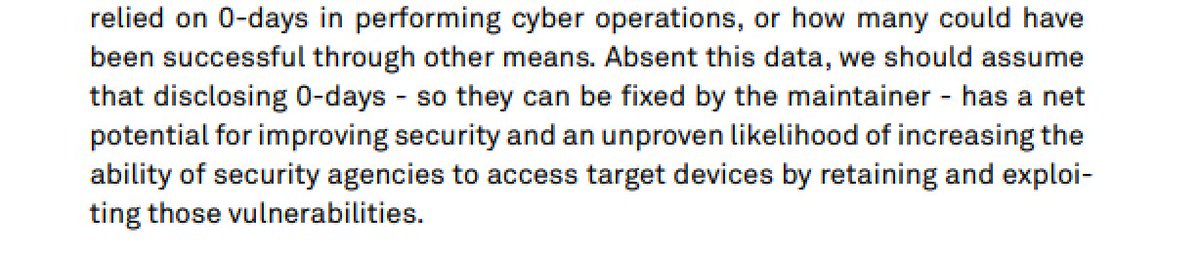
This is an especially terrible paragraph in the German VEP paper.


And for bonus negative points:

I think it's worth pointing out that making decisions on bad data is in no way better than than making decisions on no data. In fact, it's probably worse, since you have a higher confidence level in your decisions when you make them on data.

And, for the record, I engage in Cyber Policy work because we've been wandering in the desert for what seems like 40 years, and it's time to head in a direction of some sort.

Saturday, September 1, 2018

Joe Nye's latest Norms Piece


The US cyber world appears in disarray. Between the Chinese and the Russians getting super aggressive, our constant bleating about cyber norms sounds like the distress signal a lone sheep sends out when the rest of the flock has been lost to wolves.  The latest example of this is Joe Nye's paper this week on the Normative Restraints on Cyber Conflict.

The waffling starts in the Abstract with a Trumpian "Many observers have called for laws and norms to manage the growing cyber threat". Norms are deeply about established practice and the one thing you can count on any norms paper (and there are a LOT of them) to do is carefully avoid any deep discussion as to what the established practices really are.

I'm not going to pull punches: This Joseph Nye paper is a boatload of wishful thinking. It's an exemplary example of extraneous exposition and I read it carefully so you don't have to. But where I know the outside world hears weakness and withdrawal, I have different ears and hear distant Wakandan drums.

You wouldn't know it from our policy papers, but this is a period of reconstitution. While change and re-balance is no doubt a part and parcel of the cyber landscape, I think the world will be surprised at what uncloaks when this interlude is over.

Thursday, August 16, 2018

Classification/Clearance and the traditional CIA triad

I will start with my conclusion: It is far past time to completely throw out our classification/clearance system for something more modern, of which many potential examples exist. We have never had the resources and political will to do so, and suffer copiously as a result.

Even if we had the memory eraser from MIB the clearance system doesn't fit our modern needs.

In addition to failing to scale to the millions of people we now have cleared - each a specialized individual case! - the clearance system directly conflicts with the basics of the information security axioms we use to govern other complex systems. In particular, to refer to the CIA triad - we know (c.f. SNOWDEN, etc.) that the system almost encourages large scale compromise of confidential information, and not in a way that more "insider threat" programs can really prevent.

We also know that our availability to do national-security-sensitive work is strangled by an inability to get new people into the system - that the best people tend to leave because the requirements are onerous and once you've left your clearance behind to venture briefly into the commercial world, it's unlikely you'll ever get it back. What good is a system in the modern that takes two years to make a decision on someone's trustworthiness?

And the integrity of the classification system only works when we realize it is a relationship and a community, and not a gateway of privilege. If it's possible to lose your clearance for political reasons, or simply because you lost a job, or because you had any minor personal issue, then it's impossible to get reliable assessments for your intelligence community as a whole. Information does not naturally come with a meta-data label of sensitivity or scope - in fact, nearly the opposite is true, as we know from our long-used exploitation of unclassified traffic for national security purposes.

The clearance system is the hulking shadow in the back of any conference meeting on how to meet our strategic needs in the cyber domain. Even discussing norms is impossible without a better and more nuanced system for understanding and managing information-based national security risk.

Many people would say there is no better system, but even some version of the traffic-light-protocol might be a more workable option, or may be more realistically what we use now anyways, if we care to admit it.

----
https://www.cfr.org/report/sharing-classified-cyber-threat-information-private-sector
https://twitter.com/jimsciutto/status/1029810782186496000


Friday, July 13, 2018

When is a "Search" minus the Quantum Theory, for Law Professors


One issue with reactions to Carpenter is that they tend to assume that we can get clarity around how technological change affects what a search is by making up various artificial models for how telephony systems  and search processes work. The principal example of this sort of model being Orin Kerr's description in his Lawfare piece.


Example random model Orin made up. :)
If you want a better example of how complicated this sort of thing is, I recommend this Infiltrate talk on the subject of how Regin (allegedly the Brits) searched a particular cellular network, covertly.


If you want to find out when a particular search started or ended, you almost always have to develop a lot of expertise in Quantum Mechanics, starting with Heisenburg, but quickly moving into the theory of computation, etc. This is a good hobby in and of itself, but probably more than a legal professor wants to do.

So I recommend a shortcut. A search is anything that can tell a reasonable person whether or not someone is gay. It's simple and future-proof and applies to most domains.

Thursday, July 12, 2018

The Senate Meltdown/Spectre Hearing


You can browse directly to the debacle here. Everything from beginning to end of this was a nightmarish pile of people grandstanding about the wrong things.

Let's start with the point that if you're going to get upset about a bug, Meltdown and Spectre are SUPER COOL but that does not make them SUPER IMPORTANT. In the time it took Immunity to write up a really good version of and exploit for this, maybe fifty other local privilege escalation bugs have come out for basically any platform they affected. And they are hardly the first new bugclass to come along. I guarantee you every major consulting company out there has a half dozen private bugclasses. People always say "You need to be able to handle an 0day on any resilient system" and the same thing is true for bugclasses.

I'm going to quote the National Journal here.
Chairman John Thune said he “hesitates” to craft legislation that would require U.S. companies to promptly hand over information on new cyber-vulnerabilities to the government, or to deny that same information to Chinese firms.
“You’d like to see that happen sort of organically, which is what we tried to suggest today and which many of the panelists indicated is happening in a better way, a more structured way,” Thune told reporters after the hearing.
Nearly every part of this not-veiled threat is a bad idea. Assuming they could come up with a definition of "cyber-vulnerability", the companies involved do most of this work overseas. They would no doubt make sure to give this information to every government at the same time. Now we are in a race to see who can take advantage of it first?

There's a reason Intel didn't even bother to show up to this hearing. One of them is they can't afford to be seen taking sides with the USG in public. Which is precisely why this conversation happens over beers in bar somewhere instead of us counter-productively trying to browbeat them on live TV for no good reason. And we have to deal with the fact that sometimes we don't get what we want.


Here's a list of things we could have learned:

  • Bugs that private companies discover are not classified information protected and owned by the USG
  • There are consequences to our adversarial relationship with the community and with industry
  • No matter how much we blather on about coordinated disclosure systems and public private partnerships, companies have other competing interests they are not going to sacrifice just because it would be nice for the USG


Sunday, June 24, 2018

Sanger's "The Perfect Weapons" [CITATION NEEDED]

Book Link.

Everyone is very excited about the "revelation" than in order to do their APT1 paper, Mandiant (according to Sanger) hacked back. But that's not the only stunner in the book. He also points to a WMD-level cyber capability leveraged against both Iran and Russia by the United States. There are a ton of unsubstantiated claims in the book, and the conclusion is a call for "Cyber Arms Control" which feels unsupported and unspecified. But Sanger has clearly drunk deeply of the Microsoft Kool-Aid.

But to the point of the (alleged) hack-back: We should have long ago developed a public policy for this, since everyone agrees it is happening, but we seem unable to do so even in the broadest strokes. I think part of the problem is that we are always asking ourselves what we want the cyber norms to be, instead of what they actually are. I'm not sure why. It seems like an obvious place to start.

WMD theory has a pretty heavy emphasis on countervalue attacks....
This is the only mention of Kaspersky in the book - a noted absence...

This is...a threat of a WMD via Cyber.

Is this new?

This is a chilling projection.

This is not good reporting right here.

Sheesh.

Hahahahah. DO THEY?


Cypherpunks: The Vast Conflict


I've been carefully reading Richard Danzig's latest post, Technology Roulette: Managing Loss of Control as Many Militaries Pursue Technological Superiority. I want to put this piece in context - first of all, Richard Danzig is one of the best policy writers, and one of the deepest American policy thinkers currently active. Secondarily, this paper is a product of a deeply conservative government reaction to the ascendant Cypherpunk movement and is in that sense, leading the wrong direction.

Ok, that sounds melodramatic. Let me sum up the paper thusly:
  • New branches of science introduce upheaval and each comes, as a party gift, with a new weapon of mass destruction and general revolution in how war works. 
  • We used to get one a century or so, which was possible to adapt to, like a volcano that erupted every so often
    • We built treaties and political theory and tried not to kill everyone on the planet using the magic of advanced diplomacy
  • Now we are getting many new apocalyptic threats at a time
    • AI
    • 3d-Printing
    • Drones
    • Cyber War
    • Gene editing techniques
    • Nanotechnology
  • Rate of new world-changing tech is INCREASING OVER TIME.
    • Our ability to create new international political structures to adapt to new threats appears moribund


Most legal policy experts look askance on the "libertarian" views of the computer science community they have been thrust into contact with as if a Japanese commuter on the rush hour train. But the computer science world is less big L Libertarian than philosophically Cypherpunkian, tied to the simple belief that the advance of Technology is at its sum, always net positive for human liberty. Where society conflicts with the new technologies available to humanity, society should change instead of trying to restrict the march of technology.

Hence, where government experts are scared of disintermediation, as evidenced by a paranoia over Facebook's electoral reach, the computer world sees instead that newspapers were themselves centralized control over the human mind, and worthy of being discarded to the dustbin of history.

Where the FBI sees a coming crisis in the "Going Dark" saga, they find exactly no fertile ground in the technology sector, as if the field they would plant their ideas in was first salted, and then sent into space on one of Elon's rockets.

The US Government and various NGOs were both surprised and shocked at the unanimity and lack of deference of the technological community with regards to the Wassenaar cyber controls or the additional cryptographic controls the FBI wants. This resistance is not from a "Libertarian" political stance, but a from the deep current of cypherpunkism in the community.

These days, not only do Cypherpunks "write code", to quote Tim May's old maxim, but they also "have data". The pushback around Project Maven can be described on a traditional political platter, but also on a tribal "US vs THEM" map projection.

Examine the conversation around autonomous weapons. Of course, an autonomous and armed flying drone swarm can be set to kill anyone in a particular building. This is at least as geographically discriminatory as a bomb. Talks to restrict this technology even at the highest principal level so far restrict only an empty set of current and future solutions.

Part of this is the smaller market power of governments in general for advanced technology. A selfie drone is essentially 99.999% the same as a militarized drone, and this trend is now true for everything from the silicon on up, and some parts of the US Govt have started to realize their sudden weakness.

As Danzig's paper points out, the platitude that having a "human in the loop" to control automated systems is going to work is clearly false. Likewise, he argues that our addiction to classification hamstrings us when it comes to understanding systemic risk.

 The natural tendency within the national security establishment is to minimize the visibility of these issues and to avoid engagement with potentially disruptive outside actors. But this leaves technology initiatives with such a narrow a base of support that they are vulnerable to overreaction when accidents or revelations occur. The intelligence agencies should have learned this lesson when they had only weak public support in the face of backlash when their cyber documents and tools were hacked.
But his solution is anything but. We're in a race, and there's no way to get out of it based around the idea of slowing down technological development.